
How Do You Hire a Fractional CFO?
You hire a fractional CFO by defining the finance problem first, sourcing through investor and accountant referrals before marketplaces, screening for close ownership and fundraising experience, running a paid working session on your real numbers, and signing a contract with clear 90-day deliverables, a 30-day notice clause, and a conversion fee you negotiated up front.
That is the compressed version. The expanded version is below, because the gap between a CFO who fixes your cash position in 90 days and one who bills $8,000 a month for tidy spreadsheets is mostly decided before the contract gets signed.
The Signs You Need One
The clearest trigger is a cash surprise. You are profitable on paper and short on cash in the bank, and nobody on the team can tell you why or when it ends. That gap between accrual profit and the balance in the account is the exact problem a CFO exists to close.
Other signs are less dramatic. You are heading into a raise and your model is a founder-built spreadsheet that an investor will pick apart in the first diligence call. You crossed roughly $1M in revenue and you are making seven-figure decisions on gut. Your month-end close takes three weeks, so every number you act on is a month stale. A board is now asking for reporting your bookkeeper cannot produce.
One revenue marker worth holding: most companies hit the threshold somewhere between $500K and $1M, when financial decisions start carrying real downside and a bookkeeper or controller can no longer answer the questions you are asking (SDO CPA). For the deeper timing breakdown, see when a startup needs a fractional CFO.
Define the Scope and Hours Before You Look
The single biggest source of failed engagements is fuzzy scope. The founder writes "we need a CFO," the operator accepts an open-ended advisory role to win the work, and ninety days later both sides are surprised the cash forecast still does not exist. Write the scope down before you talk to anyone.
Get specific on five things. The exact finance problem in one sentence. The 90-day milestones, meaning what will be true in three months that is not true today. The scope boundaries, including whether the CFO owns the close or just reviews it. The decision authority, including any spend threshold they can approve alone. And the hours, which set the ceiling on what is realistic.
Hours map roughly to stage. The table below is a working starting point, not a rule.
| Company Stage | Typical Hours / Month | Core Scope | Monthly Range |
|---|---|---|---|
| Pre-seed / pre-revenue | 8-12 | Forecasting, basic reporting, raise prep | $2,000-$4,500 |
| Seed to Series A | 15-20 | 13-week cash forecast, board reporting, fundraise support | $4,500-$8,000 |
| Growth ($5M-$25M) | 20-40 | FP&A, unit economics, hiring the finance team | $8,000-$15,000 |
| PE-backed / scaling | 40+ | Covenants, M&A, audit prep, consolidations | $12,000-$15,000+ |
Ranges drawn from Fractional CFO School and CFO Advisors.
Where to Find Them
Start with investor referrals. If you are venture-backed, your VC has placed fractional CFOs across the portfolio and knows who fits your stage and motion. The warm tie filters for fit before you spend a single interview, which is why referral hires fail in the first 60 days far less often than cold ones.
Accountant and lawyer referrals are the second channel, and they are underused. Your outside CPA or fund admin sees dozens of finance functions and knows which operators close clean books. Founder peers who have run a fractional CFO engagement are the third, and their bias runs toward people who delivered.
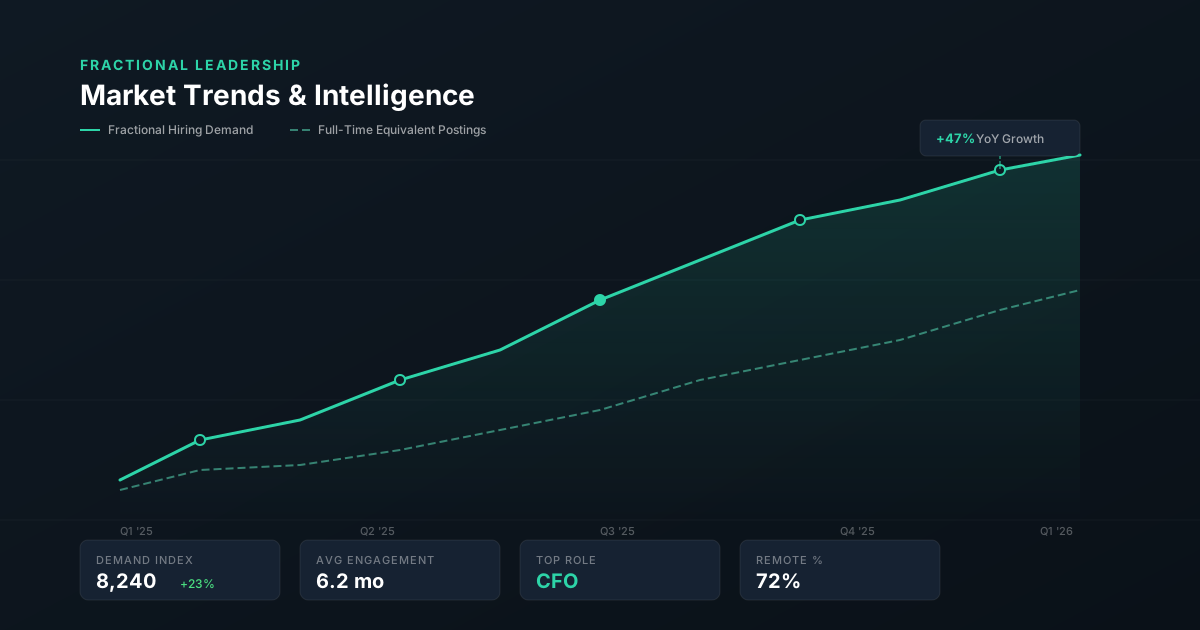
Marketplaces are channel four, for when referrals dry up or speed matters more than fit. Paro built its network around finance and accounting talent. Graphite skews toward ex-Bain and ex-McKinsey finance operators. Toptal carries a CFO bench, though it is thinner than its engineering pool. Demand pressure is real here: fractional CFO demand in the US jumped 103% year over year, and 78% of companies in the $10M to $25M band now use fractional experts, so the strong benches book up (CFO Engine, CFO Growth Advisors). For a ranked breakdown of platforms, see fractional CFO marketplaces ranked, and for the cross-role view, how to find fractional executives.
Skip LinkedIn cold outreach as a primary channel. The noise is high and the selection bias favors operators with time to post, not time to close your books.
The Interview Questions That Separate Operators
Most CFO interviews drift into philosophy. Keep yours concrete. The questions below sort the operators from the advisors, because each one has a wrong answer.
- Walk me through the last 13-week cash forecast you built. What did it change? A strong answer names the model, the tool (Excel, Jirav, Finmark), and a decision it drove. A weak answer describes the concept of a forecast.
- Who owns the monthly close in your engagements, you or a controller, and what is the close date you hold clients to? You want a specific number of days and a clear division of labor.
- Tell me about a raise you supported. What part of the model did investors push on, and how did you answer? Fundraising reps show up in the diligence detail, not the headline.
- What are the three to five metrics you would use to know this engagement is working in 60 days? If they cannot name them, they are not managing anything.
- What is the next change you would make here, who owns it, and how will we know it is done? This surfaces whether they operate with a change, an owner, and a done test, or just give advice.
- Where does your industry experience help, and where does it not transfer? SaaS deferred revenue, construction progress billing, and trust accounting are real specializations.
- What would you not touch in the first 90 days? Good operators triage. The ones who promise to fix everything at once usually fix nothing.
Stage fit beats industry fit more often than founders expect. A CFO who has run finance through three Series A raises transfers cleanly to your Series A, even from a different vertical. Industry experience matters most in regulated areas where compliance shapes the numbers (Bennett Financials).
Evaluate With a Working Session, Not Just Talk
Before signing, run a 90-minute paid working session on your real numbers. Hand over the last few months of statements and ask the candidate to walk you through how they would diagnose your cash position. Two things become obvious fast.
First, the quality of thinking. A strong CFO asks sharp questions, finds the right tradeoff, and proposes a structured plan. A weak one reaches for a generic framework deck. Second, the working relationship. You will know inside the session whether this is someone you want on a board call for the next year. Trust that read.
Cost, Contract, and the Clauses Founders Skip
Most engagements land between $3,000 and $15,000 per month, with hourly rates from roughly $175 to $450 depending on seniority and industry (The Expert CFO). Against a fully loaded full-time CFO at $300,000 to $500,000, the fractional route runs 60% to 80% cheaper, which is most of why the model exists. For the full pricing picture, see fractional CFO cost breakdown, and for the build-versus-buy math, fractional CFO vs full-time CFO.
Put four terms in the contract. The 90-day deliverables, written as outcomes rather than just hours and rate. A 30-day notice for either side, so you are not locked into a bad fit. Standard NDA plus IP assignment on work product. And, if you sourced through a marketplace, the conversion fee and its cooling-off window, negotiated before you fall for the candidate.
The conversion clause is where marketplace hires get expensive. Bringing a CFO in-house through a platform can cost two to four months of marketplace margin, which sometimes exceeds a recruiter fee outright. Some networks, like Fractional Jobs, charge a one-time referral fee and let you own the relationship clean (Opstart). Read which model you are signing. Ask about the replacement guarantee too, and confirm whether it covers only a new match or the time you lost on the first one.
Onboarding and the First 90 Days
Structure the start so misalignment surfaces in week four, not month four. The first week is financial discovery: historical statements, burn rate, and the obvious red flags. Days three to seven add stakeholder interviews with you, the sales lead, and key vendors, plus a first pass at the 13-week cash forecast to establish credibility early.
By day 30, you want a report-out: what the CFO found, the proposed 90-day priorities, and the metrics they will run against. If that report does not match what you expected, deal with it that week. The cost of a mismatch at day 30 is a conversation. At day 90 it is a sunk-cost decision you will rationalize.
Done well, the markers are concrete. Close time dropping from around 20 days toward 7, a rolling forecast that updates instead of gathering dust, and a short list of margin opportunities worth chasing (Bennett Financials). Most companies see clear ROI by month four or five, not month one.
Red Flags to Avoid
Watch for the operator who creates dependency instead of reducing it. A good fractional CFO builds a function that runs without them and trains your team toward it. One who makes themselves the only person who understands the model is protecting a retainer, not your company.
The other red flags are answers, not credentials. No clean metrics for measuring progress. A wobbly answer on who does the close. Advice with no execution format behind it. A pitch heavy on cost-cutting with nothing on growth. And the candidate who promises to fix everything in 30 days, which tells you they have not run a real 90-day plan before (Bennett Financials). One vague answer in an interview is a yellow flag. Two is a pass.
FAQs
How long does it take to hire a fractional CFO?
Plan for 4 to 6 weeks from scope definition to start. Investor and accountant referrals can close in 2 to 3 weeks because the fit is pre-filtered. Marketplace sourcing usually runs 3 to 5 weeks. Add a week or two if you run parallel candidates and a paid working session, which you should.
What does a fractional CFO cost?
Most engagements run $3,000 to $15,000 per month for 10 to 40 hours, with hourly rates of roughly $175 to $450 by seniority and industry. That is 60% to 80% below the $300,000 to $500,000 fully loaded cost of a full-time CFO, which is the main reason early and growth-stage companies choose fractional.
What is the single most important thing to screen for?
Close ownership and a real 13-week cash forecast. Ask who owns the monthly close, what date they hold clients to, and to walk through a forecast they built and a decision it drove. Operators answer with specifics. Advisors answer with concepts. That one exchange separates most candidates.
Should the fractional CFO have experience in my exact industry?
Stage fit usually matters more than industry fit. A CFO who has run finance through several Series A raises transfers across verticals. Industry experience matters most in regulated areas like healthcare and financial services, or where revenue recognition is unusual, such as SaaS deferred revenue or construction progress billing.
Can I hire directly or do I need a marketplace?
Direct hire through referrals is often 25% to 40% cheaper for the same talent and gives you a clean relationship with no conversion fee. Use a marketplace when you need speed under two weeks or have no warm referrals. After a first engagement, your own network usually outperforms platforms.
What contract terms matter most?
Written 90-day deliverables, a 30-day termination notice for either side, NDA plus IP assignment, and, for marketplace hires, a conversion fee and cooling-off period negotiated up front. The conversion clause is the costly one. Bringing a marketplace CFO in-house can run two to four months of platform margin.
What should be true after the first 90 days?
A rolling 13-week cash forecast that stays current, a faster close (often from around 20 days toward 7), a metrics dashboard, and a short list of margin or cost opportunities. Expect a clear day-30 report-out first. If it does not match your expectations, address it that week, not at day 90.
Sources
- Fractional CFO School: Fractional CFO Rates Guide
- The Expert CFO: Fair Fractional CFO Hourly Rate Pricing Guide
- SDO CPA: When to Hire a Fractional CFO
- Bennett Financials: What Is a Fractional CFO
- Bennett Financials: Fractional CFO Onboarding First 90 Days
- CFO Engine: Why Fractional CFO Demand Surged